Service ItemId: 929ae7db614844e7a09d74cdb053761f
Has Versioned Data: false
Max Record Count: 2000
Supported query Formats: JSON
Supports applyEdits with GlobalIds: False
Supports Shared Templates: True
All Layers and Tables
Layers:
- USA Wetlands (0)
Description:
Wetlands are areas where water is present at or near the surface of
the soil during at least part of the year. Wetlands provide habitat for
many species of plants and animals that are adapted to living in wet
habitats. Wetlands form characteristic soils, absorb pollutants and
excess nutrients from aquatic systems, help buffer the effects of high
flows, and recharge groundwater. Data on the distribution and type of
wetland play an important role in land use planning and several federal
and state laws require that wetlands be considered during the planning
process.
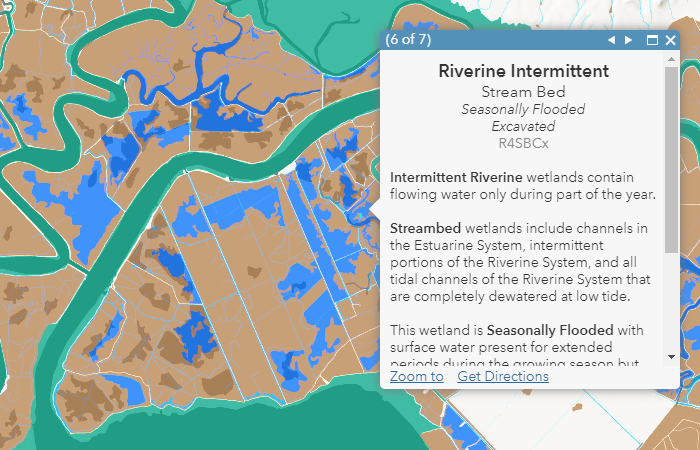
The National Wetlands Inventory (NWI) was designed to assist land managers in wetland conservation efforts. The NWI is managed by the US Fish and Wildlife Service.
Dataset Summary
Phenomenon Mapped: Wetlands
Coordinate System: Web Mercator Auxiliary Sphere
Extent: 50 United States plus Puerto Rico, the US Virgin Islands and the Northern Mariana Islands
Visible Scale: The data is visible at scales from 1:144,000 to 1:1,000. An imagery layer created from this dataset is also available which you can also use to quickly draw wetlands at scales smaller than 1:144,000.
Resolution/Tolerance: 0.0001 meters/0.001 meters
Number of Features: 34,482,400 diced, after applying a 50,000 vertex limit.
Feature Limit: 10,000
Source: U.S. Fish and Wildlife Service
Publication Date: November 29, 2021
ArcGIS Server URL: https://landscape11.arcgis.com/arcgis/
This layer was created from the November 29, 2021 version of the NWI. The
original NWI features were downloaded from USFWS on January 25, 2022.
They were then converted to a single part feature class using the Multipart To Singlepart tool. After that, the Dice tool
was used to break up features larger than 50,000 vertices. The Repair Geometry
tool was run on the features, using tool defaults.
NWI derived attributes:
Wetland Code - a code that identifies specific attributes of the wetland
Wetland Type - one of 8 wetland types
Area - area of the wetland in acres
Esri created attributes:
System - code indicating the system and subsystem of the wetland
Class - code indicating the class and subclass of the wetland
Modifier
1, Modifier 2, Modifier 3, Modifier 4 - these four fields contain
letter codes for modifiers applied to the wetland description
System Name - the name of the system (Marine, Estuarine, Riverine, Lacustrine, or Palustrine)
Subsystem Name - the name of the subsystem
Class Name - the name of the class
Subclass Name - the name of the subclass
Modifier
1 Name, Modifier 2 Name, Modifier 3 Name , Modifier 4 Name - these four
fields contain names for modifiers applied to the wetland description
Popup Header - this field contains a text string that is used to create the header in the default pop-up
System Text - this field contains a text string that is used to create the system description text in the default pop-up
Class Text - this field contains a text string that is used to create the class description text in the default pop-up
Modifier Text - this field contains a text string that is used to create the modifier description text in the default pop-up
Species Text - this field contains a text string that is used to create the species description text in the default pop-up
Codes, names, and text fields were derived from the publication Classification of Wetlands and Deepwater Habitats of the United States.
What can you do with this Feature Layer?
ArcGIS Online
- Add this layer to a map in the map viewer. The layer is limited to scales of approximately 1:144,000 or larger but an imagery layer created from the same data can be used at smaller scales to produce a webmap that displays across the full scale range. The layer or a map containing it can be used in an application.
- Change the layer’s transparency and set its visibility range
- Open the layer’s attribute table and make selections and apply filters. Selections made in the map or table are reflected in the other. Center on selection allows you to zoom to features selected in the map or table and show selected records allows you to view the selected records in the table.
- Change the layer’s style and filter the
data. For example, you could set a filter for System Text = 'Palustrine' to create a map of palustrine wetlands only.
- Add labels and set their properties
- Customize the pop-up
- Add this layer to a 2d or 3d map. The same scale limit as Online applies in Pro
- Use as an input to geoprocessing. For example, copy features allows you to select then export portions of the data to a new feature class.
- Change the symbology and the attribute field used to symbolize the data
- Open table and make interactive selections with the map
- Modify the pop-ups
- Apply Definition Queries to create sub-sets of the layer
Copyright Text: Source: USFWS, Esri
Spatial Reference: 102722 (3734)
Initial Extent:
-
XMin: 1445793.52822005
YMin: 713631.63302749
XMax: 1504107.77431784
YMax: 768779.49472178
Spatial Reference: 102722 (3734)
-
XMin: 1444697.39614921
YMin: 718042.214955309
XMax: 1498294.94251828
YMax: 762337.492739597
Spatial Reference: 102722 (3734)
Child Resources: Info SharedTemplates
Supported Operations: Query ConvertFormat Get Estimates